Showing posts with label Japanese Children's Theatre. Show all posts

Sunday, August 2, 2009

Peekaboo


It is summer holidays in Japan and there are festivals everywhere you go. Japan loves it’s festivals and they take on many shapes and sizes. Each town has its traditional ‘Matsuri’ (Festival) which generally involves the men in the town gathering to cry ‘Washoi! Washoi!’ as they carry large decorated floats through the town wearing nothing but loincloths to the local Shinto shrine. Then there are the fireworks festivals, these take place during the summer and young and old gather by riverbanks to delight in these brilliant displays, wearing ‘ukatas’ (summer kimonos) and waving ‘uchiwas’ (fans). There are all kinds of festivals: rock festivals, beach festivals, full moon festivals and of particular interest to me this visit, children’s festivals.

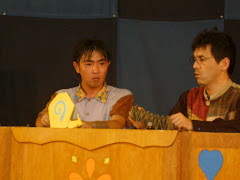
I have travelled to Tokyo with the Kazenoko Kyushu for a performance of their acclaimed work for zero to three year olds, Peekaboo which is being performed at a Summer Children's Festival at the Town Hall in Shibuya. The show was first created in 1985 when Kazenoko director, Ken Nakajima had just started a family of his own. With a baby and a toddler at home, he was inspired to create a show for this age group; something no one in Japan had ever done before. He told the three young actors to create an intimate show for a small audience, “This is a special show for Kazenoko- it is a true investment in this age group so I don’t mind if it makes a loss”, he said to his cast.

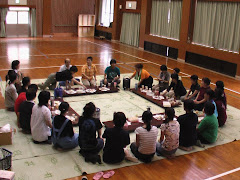
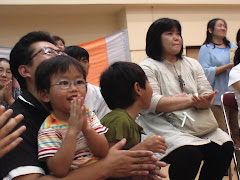
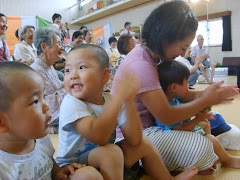
And it is indeed intimate. The audience sit on the floor in the round and I look across the circular playing space at the mothers and fathers nursing their small children. The atmosphere is calm but not without occasional cries, screams and toddlers who feel suddenly inspired to run across the stage. The show begins with song. Jiro, Hiroko and Saki, who are the Peekaboo ensemble, have beautiful voices and sing in sweet harmonies. All three also happen to be very cute and petite. I tell them later in the post show feedback session that I want to take them home to Australia with me…which would be easy because they would probably all fit in my 60L backpack.

The actors start by singing a sweet peekaboo song and interact gently with children in the front couple of rows leaning in close and singing ‘peekaboo!’. We learn early on when a little baby gets a fright and starts to cry that this is okay too- the actors are not unnerved, they nod in understanding and it is part of the experience. The actors play Japanese versions of “Row- row row the Boat”, holding the hands of the children, they play “Drop the hankie” and then the handkerchiefs become birds and they flutter through the audience and land on the shoulders and heads of the children. It is very interactive.

The whole experience is linked beautifully with song and half way through the show, each of the actors produce an instrument (a guitar, a violin and a cello) and as the room fills with the rich sound of the strings, everyone starts swaying. The children love the music and it soothes any cries.

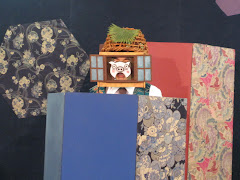
The show climaxes with a story about ‘Ojisan’s Doubutsu’ (Grandpa’s Animals). Jiro-san plays the Grandpa and sits on a clever swivelling stool in centre stage and is visited by a chicken, a mouse, a lion and an octopus (all expertly physicalised by Saki and Hiroko and each unique and comic). It is a simple little story and holds the attention of the audience right through to its conclusion.

As with the other Kazenoko shows that I have seen for toddlers up, the story telling is only a small part of the show. Instead, the various forms of play and games leading up to the story occupy the bulk of the performance.

After the show I talk with the director, Ken Nakajima and he explains that apart from Jiro-san, the actors have changed many times since the first season. And as the members change, so too does the show, little by little. He explains that ‘Peekaboo’ is a very important playground for Kazenoko Kyushu actors to discover whether or not they can play with and for children. It requires great honesty, an ability to be in the moment and great sensitivity to the audience and the wide variety of reactions one experiences when performing for babies and toddlers.

Cut and paste the following link for a Peekaboo at Peekaboo!

http://www.kazenoko-kyushu.or.jp/sakuhin/peekaboo/top.htm

Tuesday, July 7, 2009

One Big Family


I have only just arrived in Fukuoka and already the hospitality shown to me by Kazenoko Theatre Company is overwhelming. This is approximately (I have lost count) my seventh trip to Japan so you would think that I would be getting used to the way that the Japanese go out of their way for Western guests, however, it never ceases to amaze me. Maybe this is because they always underplay the special things that they do for you, so when they happen they are a great surprise.

Asano-san, meets me at the airport on Sunday night and informs me on the drive back into town that the following few weeks would be a ‘hardo scheduru’. By the way, many English words such as these have made their way into the Japanese language…which makes life a little easier when you are lost for vocab…simply say the English word in a Japanese accent and you have about 50% more chance of being understood. My 'Hardo Scheduru' will include travelling with Kazenoko's shows to Kagoshima, Nagasaki, and a small island, ironically called 'Oshima' (Big Island).

As Asano-san helps me with my luggage into the apartment block , she says ‘Ashita yukuri yasunde kudasai’- please rest slowly tomorrow. She then adds, in Japanese, “And then come to the Kazenoko office at 5pm for a small meeting with the members.” I thank her for greeting me and we say 'Oyasuminasai' (goodnight).

After a day of soaking up Japanese TV convincing myself that it as effective as studying my textbook, I make my way to the Kazenoko office, carefully following the directions that Asano-san gave me. It is an easy twenty- minute walk from my apartment through a really fun part of town- many funky shops, fresh fruit stalls, 'Izakayas' (bars) and resturaunts. Just as I think I am almost there, I realise I am totally lost, but thankfully and kind of magically, Asano-san appears from nowhere on her bicycle to rescue me.

She shows me to the office which, as it turns out, is a big old house (same as Kazenoko in Tokyo). The offices are down stairs, with a small rehearsal room and I learn later in the night that company actor Jiro's 75 year old mum lives upstairs and another member's 27 yr old son lives in another part of the house. At this stage I started to suspect that maybe Kazenoko is one big family.

I follow Asano-san into the house, taking off my boots and climbing into the slippers she provides. I am relieved to enter the air conditioned office, it is very, very hot and sticky outside, it seems I have arrived just in time for 'Tsuyu' (the wet season). Everyone is still working at their desks and stop to look up at me. Feeling bad that I have interrupted, I bow to the room and say 'Minasan, Hajimemashite!' (Nice to meet you all!). I receive an instant round of applause, and one by one, I am greeted with personal introductions, bows and business cards. How will I remember all these names?!

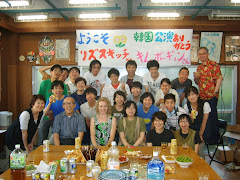
Then after ten minutes, thinking that I have met everyone, I am shown into the rehearsal room where there is a sign 'Yokoso Rizu Sukichi to Kimu Bokyun -san' (Welcome Liz Skitch and Kimu Bokyun) and big spread of food and drinks. I am greeted by President Kariya-san, who then introduces me to Bokyun -san, who is currently visiting from Korea promoting her show “Tokei Tomatta Hi” (The Day the Watch Stopped) and will soon be joined by the rest of her ensemble, 'Sadari Theatre Company'. I discover that I will get to see “Tokei Tomatta Hi” both in Tokyo and at the Kijimuna Festival in Okinawa. It is a co-production between Sadari Theatre Company and Kazenoko. I look forward to finding out more from Bokyun-san over the coming weeks about her company and the show’s journey from its birth (four years ago) to its current tour of Japan.

The room then fills with the company members (there are 23 at the office today). And once drinks are organised for everyone, we 'Kampai!' (Cheers!). Then one by one, the members introduce themselves. I recognise Hayashi-san, the very friendly older manager who speaks English from the ASSITEJ festival, which we attended in Adelaide in May last year. It turns out that he is married to Suehiro-san, the lovely lady who has been organising my trip (we have exchanged many e-mails over the last few months). Suehiro-san already feels like my 'Okasan' (Mother), inquiring throughout the night about my health and telling me many times to take care not to catch a cold.

I also recognise the cast of “Nande-man”, who I met in Tokyo last year, Mari-san and Koike-san. Mari-san shares the story with the group about how last year after seeing their show that I told the cast that I had laughed so much that I nearly wet myself- it is a bit of an embarrassing story but is greeted with another round of applause. Thank goodness this company has a sense of humour!

Then it is my turn. I harness by best Japanese (now aided by the beer I have been consuming) to tell the group about my company's approach to performing and directing which is inspired by my teacher, Philippe Gaulier. I believe if the actors are having fun on stage then the audience has fun watching the show and that is the most important thing in theatre. I then say that this is why I love the work of Kazenoko- because of the joy in their work (or as Gaulier calls it in French, “Le Jeu”). And finally “I am here to learn as much as possible about how Kazenoko creates plays, how you have sustained as a company for 59 years and how you adapt your work for an international audience."

We 'Kampai' again, this time I suggest a “Cheers Mate” and the night rolls by. Eating, drinking, conversation and LOADS of laughter. We talk theatre, we talk comedy, we talk politics and we even end up improvising and miming eating our favourite foods for each other!

At about 11pm Suehiro-san emerges (she has been working in the office) and in her warm and motherly fashion and suggests it might be time for us all to go home. Like good children, we do as we are told, pack up and say our 'Oyasuminasais (goodnights). This confirms my suspicion, Kazenoko Kyushu really is ONE BIG FAMILY.